Today I’m gonna blog a little bit about fabrics and fibres! What’s your first thought when someone says to you:
“I love that silk fabric!” You are probably going to assume something light and airy. Maybe a chiffon if you’re feeling fancy.
But did you know? You can get heavy weighted silk fabrics! This is because its not just what the fabric is made of, but rather what types of fibre are used, and how they are used! I like to think of it like this; Silk, polyester, wool, etc, are like what type of paint you want to use, and words like; chiffon, velvet, organza, are the type of canvas you’re going to paint on. So for example, you might want to use oil paints on a piece of driftwood; or a silk velvet. As a tactile learner, I find having a comparasion like this helpful to imagine the difference.
This website: https://www.biddlesawyersilks.com/types-of-silk/ is a great example of how different fabrics are made, by using just silk fibre alone!
Why is it important to know this? For many different reasons – either texture, price, accuracy if you are creating a replica, some fabricsor fibres might be a fire risk, what size needle you might need, best way to hem, or how it frays, the list goes on!

Above is a microscopic photograph of some different fibres. You can really see a difference here between the uneven bumps and lumps from the natural fibres, compared to the manmade polyester.
Speaking of polyester, this graph is a great breakdown of the main types of fibre you can get! Natural, Manmade, and Semi-Synthetic. It’s exactly as it sounds – natural, eg plant or animal based, manmade is entirely… well manmade, your PVC, plastics, etc, and then semi-synthetic is a mix of both! Like your polycottons.
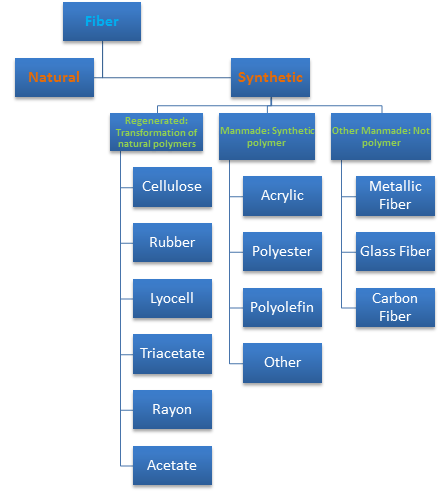
I really recommend looking at this page: https://www.globalspec.com/learnmore/materials_chemicals_adhesives/composites_textiles_reinforcements/synthetic_fibers_fabrics_polymer_textiles as it has some great information on how fabrics are made, and also a useful chart on what they can be used for. It is a much more industrial look, but helpful all the same!
For the last part of this blog, I want to talk a small bit about identifying what kind of fabric you have – maybe you have been gifted it, and you aren’t too sure what it is composed of; my answer is, set it on fire!
Yes really, but also, carefully, in a controlled, OUTSIDE, environment. Animal fibres when burnt will smell like burnt hair. Plant based ones in my experience are similar to when you burn paper. Synthetic and semi synthetic can be a bit of a wild west in their reaction – Some melt, some almost instantly catch fire and disappear, and some you really have to coax to catch a light.
Better than me trying to explain it though, here is a video of myself constructing a costume that needed lots of aging – the client wanted it to look like long, long after an apocolyptic event.
Have fun experimented with fabrics and fibres, and if you want to set things on fire – PLEASE do it outside, and keep a spray bottle of water to hand just incase it looks like it is getting out of hand!
 Quillightful
Leave a comment